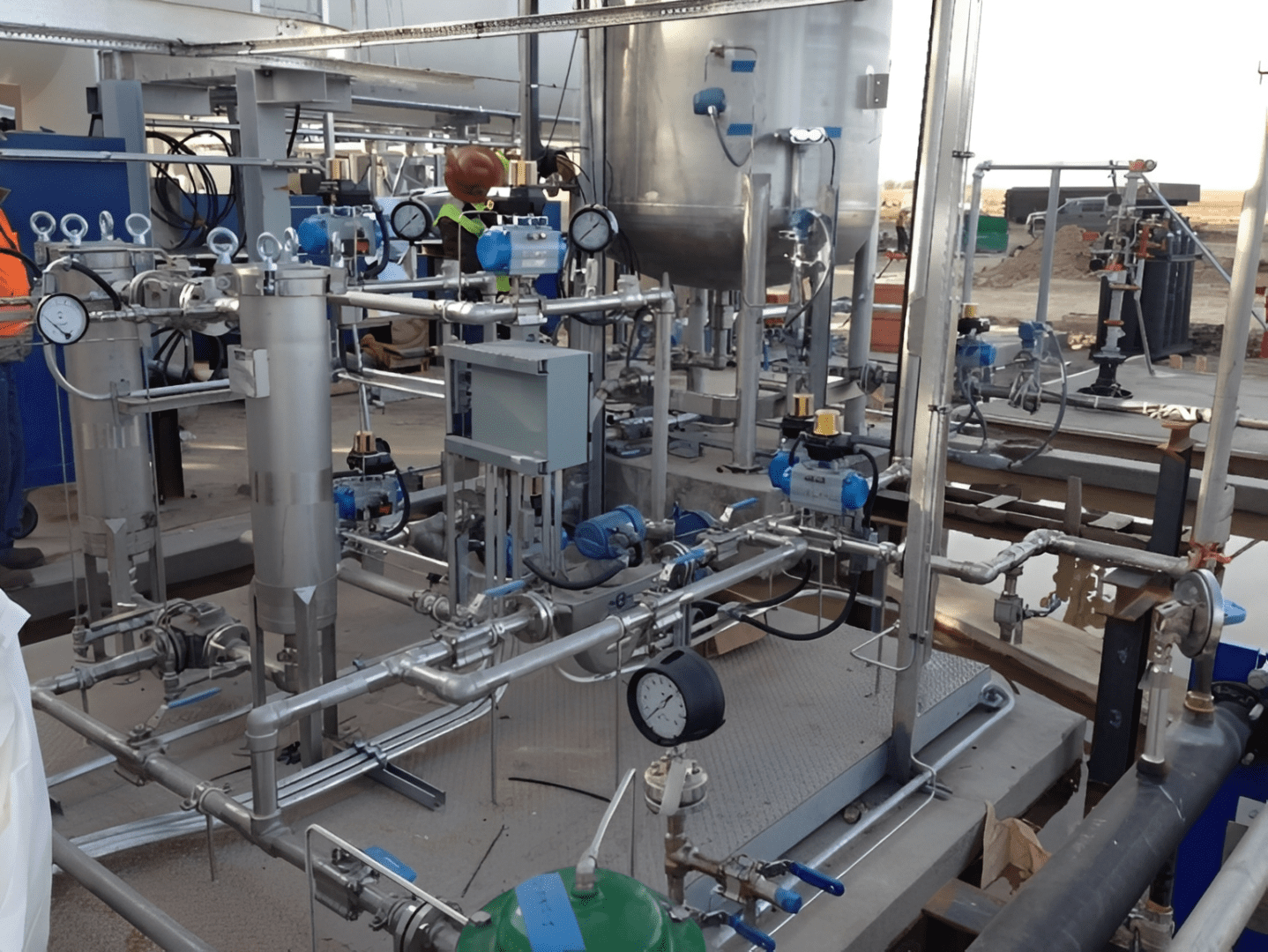

Ammonium Carbonate (NH4)2CO3 ASME Storage Tanks
Ammonium carbonate storage requires specialized engineering due to the chemical’s tendency to undergo thermal decomposition into ammonia, carbon dioxide, and water vapor at temperatures exceeding 130°F. Unlike stable aqueous solutions, ammonium carbonate is often stored as a saturated liquid or slurry, requiring precise thermal management to prevent crystallization.
Engineering & Design Features
- Corrosion Resistance: Constructed using 316L Stainless Steel to withstand the corrosive nature of the carbonate ion.
- Thermal Management: * Equipped with internal heating coils or external heat tracing.
- High-performance insulation packages (mineral wool or polyisocyanurate) to minimize thermal cycling.
- "Low-watt density" heating to avoid localized boiling and chemical decomposition at the tank walls.
- Venting & Emission Control: Specialized venting strategies integrated with RM Technologies Scrubbers to manage continuous CO2 and ammonia off-gassing.
- Advanced Monitoring: Automated level sensing and dual-element RTDs (placed at the bottom and middle) for accurate, PLC-monitored temperature profiles.

Stability & Crystallization Prevention Guide
Proper management of ammonium carbonate is a balance between preventing "salting out" (crystallization) and avoiding thermal decomposition (gasification).
1. The Temperature-Concentration Relationship
- The Danger Zone: A 30% solution will crystallize if temperatures drop below 60°F.
- The RM Standard: We maintain a storage temperature of 80°F to 90°F. This provides a safety buffer against cold-weather crystallization while staying well below the 130°F decomposition threshold.
2. Thermal Best Practices
- External Heat Tracing: We prefer external electric heat tracing over immersion heaters to ensure a uniform heat profile and eliminate "hot spots."
- Redundant Sensing: Dual-element RTDs ensure the PLC identifies the coldest points in the liquid mass to prevent localized solidification.
3. Eliminating "Dead-Leg" Failures
Crystallization most often occurs in piping and valves rather than the tank itself.
- Full-Loop Tracing: Every inch of suction and discharge piping, including valves and supports, must be traced and insulated to prevent "cold bridges."
- Automated Flushing: RM Technologies systems include a Water Flush cycle that purges lines with warm demineralized water before extended shutdowns.
The RM Technologies Design Advantage
Unlike standard storage vessels, our carbonate systems feature Active Recirculation Loops. By keeping the reagent in constant motion, we eliminate stagnant zones where crystals are likely to form. This active mixing, combined with precision thermal control, ensures your reagent remains in a stable, pumpable state for consistent industrial injection.