
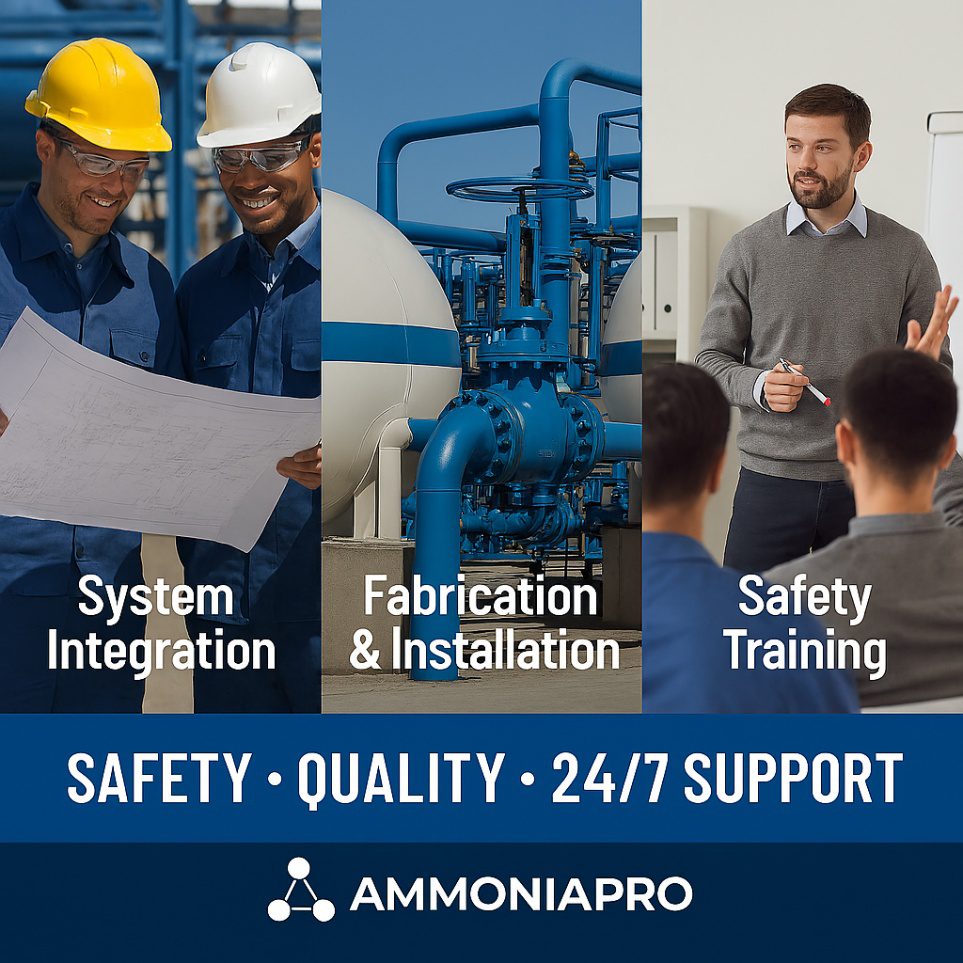
Advanced Engineering Solutions for Ammonia Systems
Conceptual Design is the foundational phase in the lifecycle of any ammonia system—whether for industrial refrigeration, chemical processing, or green energy applications like marine fuel. At RM Technologies, we focus on establishing technical viability, defining operational requirements, and providing the economic justification necessary to move your project from an idea to a high-performance reality. Our engineering scope also includes electrical load planning, including accurate 3-phase heater amp draw calculations for safe and efficient system integration.
I. Project Initiation and Feasibility Study
Before any equipment is purchased, we conduct a rigorous feasibility study to ensure your objectives can be met within practical and regulatory constraints.
1. Defining System Scope & Objectives
- Application-Specific Design: Tailoring the system for refrigeration, chemical synthesis, power generation, or fuel bunkering.
- Determining Ammonia Form: Choosing between Anhydrous Ammonia (NH₃) for purity/efficiency or Aqua Ammonia for safer handling based on your facility's needs.
- Establishing KPIs: Setting clear targets for throughput, energy consumption, and safety compliance.
2. Process Modeling & Route Selection
- Technology Pathways: Selecting the right route, such as conventional Steam Methane Reforming (SMR) or "Green Ammonia" via electrolysis.
- Mass and Energy Balance: Calculating feedstock inputs versus expected outputs.
- Heat Integration: Utilizing techniques like Pinch Analysis to maximize energy recovery, which significantly reduces long-term operating costs.
- Electrical Engineering Support: Performing preliminary power demand studies and 3-phase heater amp draw evaluations for integrated process heating systems.
II. Conceptual Design & Preliminary Engineering
In this phase, we translate feasibility findings into the foundational technical documents required for detailed engineering and procurement.
1. Process Flow Diagram (PFD) Development
We create a "box-level design" that graphically represents the main equipment, process streams, and critical control points, providing a clear map of the entire system flow.
2. Component Selection & Sizing
We perform preliminary sizing for reactors, compressors, heat exchangers, and storage solutions. Our selection process accounts for ammonia's unique properties, specifically its corrosive reaction with copper and brass, ensuring only compatible materials are used. Electrical sizing considerations, including voltage requirements and 3-phase heater amp draw calculations, are incorporated during early-stage engineering.
3. Site Layout & Hazard Zoning
We develop conceptual layouts that prioritize safety. This includes:
- Safety Barrier Positioning: Separating hazard zones from personnel areas.
- Site Selection Support: Evaluating infrastructure access, environmental factors, and proximity to transport hubs.
- Infrastructure Optimization: Strategically locating ventilation and leak detection arrays.
III. Safety, Regulatory, and Economic Assessment Feasibility Study
Because of ammonia’s toxicity, safety and financial viability are integrated into our engineering process from day one.
1. Risk Management & Safety Strategy
- HAZID Workshops: Early-stage Hazard Identification to mitigate risks before construction begins.
- Advanced Safety Barriers: Designing automated emergency shutdowns, leak detection networks, and secondary containment.
- Compliance Verification: Ensuring the design aligns with PSM (Process Safety Management), RMP (Risk Management Program), and local air quality permits.
2. Techno-Economic Analysis (TEA)
We provide a comprehensive financial justification for the project, including:
- CAPEX/OPEX Estimates: Detailed projections for construction costs versus long-term utility and maintenance expenses.
- Cost-Benefit Analysis: Comparing upfront investment against long-term operational efficiency to ensure commercial viability.
The completion of the Conceptual Design package provides the approved basis for subsequent stages of engineering, procurement, and fabrication.