
Ammonia, Future in Clean Energy
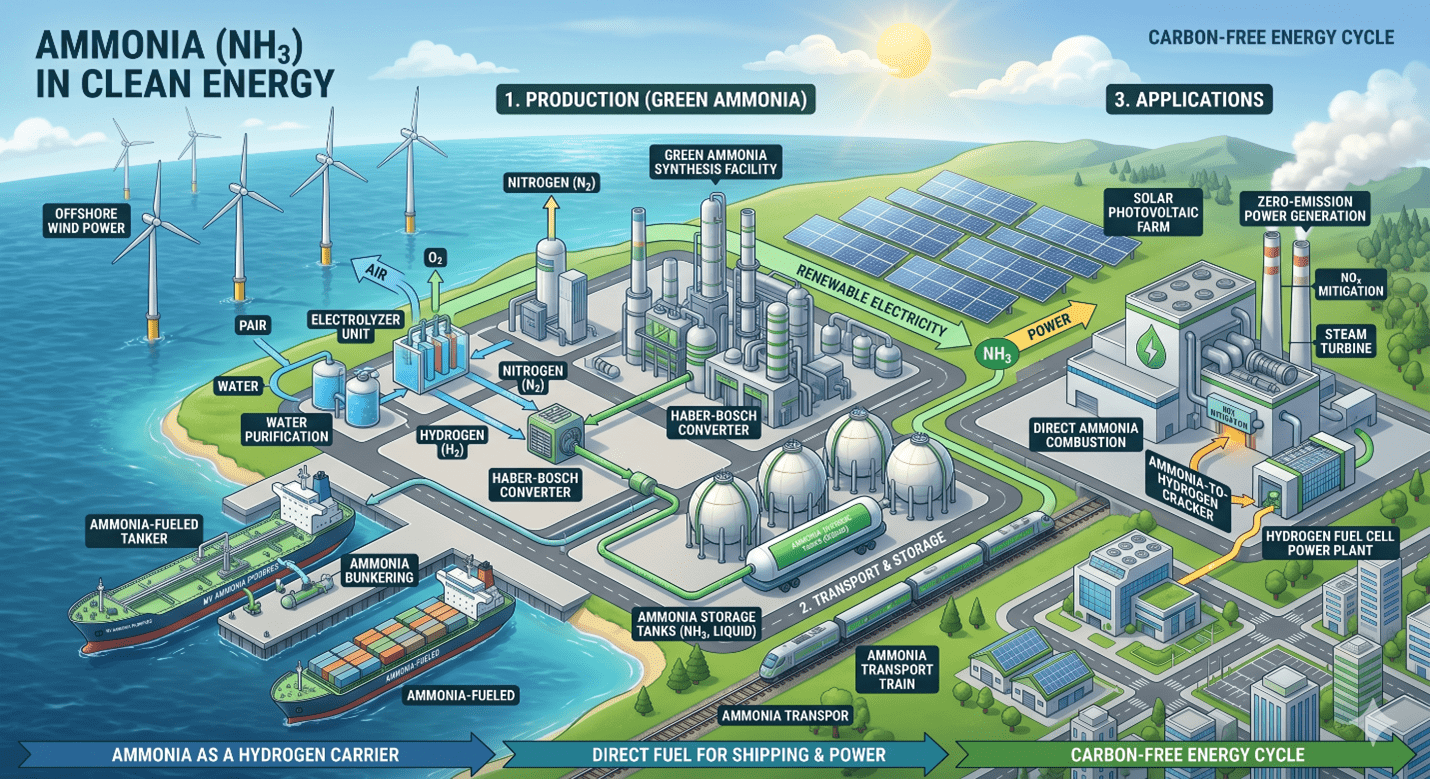
Ammonia is increasingly recognized as a vital component in the transition to clean energy. While conventionally known for its use in fertilizers, its unique chemical properties make it an attractive carbon-free fuel and an efficient carrier for hydrogen.
The primary benefit of ammonia in the clean energy sector is that its molecule contains no carbon, meaning its use in energy applications—whether through direct combustion or in fuel cells—does not produce carbon dioxide, the principal greenhouse gas.
Key Roles of Ammonia in Clean Energy
Ammonia’s versatility allows it to serve two major functions in a sustainable energy economy:
- Zero-Carbon Fuel Source: Ammonia can be directly used as a fuel to generate power.
- Direct Combustion: It can be burned in internal combustion engines (like gasoline or diesel) and gas turbines. Major industries are developing large-scale ammonia engines, particularly for sectors that are difficult to decarbonize, such as maritime shipping and heavy-duty transport.
- Fuel Cells: Ammonia can be fed into fuel cells to generate electricity directly through electrochemical reactions.
- Cracking into Hydrogen: Ammonia can be “cracked” back into its constituent parts—hydrogen and nitrogen. The resulting hydrogen can then be used in hydrogen fuel cells or engines. Recent technological advances are focusing on making this cracking process more efficient and scalable.
- Efficient Hydrogen Carrier and Energy Storage: While hydrogen is a potent clean fuel, it is difficult and expensive to transport and store as a gas. Ammonia solves many of these logistical challenges.
- High Energy Density: Ammonia has a significantly higher energy density than compressed hydrogen gas. It can store more energy in the same amount of space.
- Easier Handling and Transport: Ammonia liquefies at much more manageable temperatures and pressures (roughly -33°C at atmospheric pressure) than hydrogen. This makes it easier, safer, and cheaper to transport over long distances using existing infrastructure, such as pipelines, road tankers, and ships.
Categorizing Ammonia Production
The “cleanliness” of ammonia as an energy source depends entirely on how it is produced.
- Green Ammonia: This is the ideal clean energy source. It is produced using renewable energy sources (like solar, wind, or hydropower) to power the electrolysis of water to generate hydrogen. The hydrogen is then combined with nitrogen separated from the air using the Haber-Bosch process, with the entire cycle being powered by sustainable electricity. Green ammonia production results in virtually zero carbon emissions.
- Blue Ammonia: This type is produced using traditional methods (from natural gas), but the resulting CO2 emissions are captured and stored using carbon capture and storage (CCS) technology. It has a significantly lower carbon footprint than gray ammonia but is not entirely carbon-free.
- Gray Ammonia: This is the current conventional method of production, using natural gas as a feedstock without carbon capture. This process is energy-intensive and results in significant CO2 emissions. Gray ammonia is not considered a clean energy source.
Potential Applications and Advantages
The adoption of ammonia as a clean energy tool offers several advantages across various sectors:
- Maritime Shipping: The shipping industry is a major polluter, and ammonia is a leading candidate for a long-range, carbon-free fuel that can meet the industry’s emissions reduction targets.
- Power Generation: Ammonia can be used to generate electricity in power plants, both as a primary fuel and by “co-firing” it alongside conventional fuels to reduce emissions from existing infrastructure.
- Industrial Processes: It can provide a low-carbon fuel option for high-heat industrial processes like steel and cement production.
- Intermittent Renewable Energy Storage: Green ammonia can serve as a form of long-term energy storage, converting surplus renewable electricity generated during productive periods into a storable chemical fuel for use when renewable generation is low.
- Leveraging Existing Infrastructure: A global infrastructure for producing, transporting, and handling ammonia already exists for the fertilizer industry. This well-established logistical framework can be adapted and scaled for its new role in the energy sector.
Challenges and Environmental Considerations
While highly promising, the transition to an ammonia-based clean energy economy faces significant hurdles and environmental risks:
- NOx Emissions during Combustion: Although burning ammonia does not produce CO2, it can generate nitrogen oxides NOx, which are harmful air pollutants and potent greenhouse gases. Managing and minimizing NOx emissions through advanced engine design and catalytic technologies is a critical engineering challenge.
- Toxicity and Safety: Ammonia is highly toxic and can be hazardous if handled improperly. The widespread use of ammonia as a fuel will require stringent safety regulations and public handling protocols to manage the risks of leaks or accidents.
- Production Costs: Currently, producing green ammonia is significantly more expensive than producing gray ammonia or using traditional fossil fuels. Reducing the cost of electrolyzers and renewable energy is essential to make green ammonia commercially viable.
- Energy Efficiency of the Full Cycle: Converting electricity to hydrogen, then to ammonia, transporting it, and then either burning it or cracking it back to hydrogen is a less energy-efficient process than using renewable electricity directly. The specific energy use-case must justify these efficiency losses.
- N2O Environmental Impact: A mismanaged ammonia economy could potentially lead to increased emissions of nitrous oxide N2O, a potent greenhouse gas, which would negate some of the benefits of decarbonization. Proper system design and regulation are essential to mitigate this risk.
R. M. Technologies is acknowledged for quality products and service. Our extensive engineering expertise with ammonia, combined with our product knowledge and highly trained personnel, provides you with the convenience of dealing with one company for all your ammonia project requirements.
For additional information or specific application, please contact RM Technologies of America at: (800) 775-4280 or sales@rmtech.net
